
Business Registration in Singapore: A Guide for Foreign Entrepreneurs (2026)
Singapore remains a competitive hub for foreign investment, consistently ranking atop the world’s biggest economies. Based on the numbers recorded by the Accounting and Corporate Regulatory Authority (ACRA), there is a 2% increase in business formations and registry in 2025 compared to 2024. With Foreign Direct Investment (FDI) inflows reaching record high numbers in recent years and topping the list among its ASEAN counterparts. As we stepped into 2026, the Monetary Authority of Singapore (MAS) projected a steady economic growth across various sectors, with the demand for Artificial Technology (AI) and relevant industries leading the pace.
With a stable political climate, a transparent legal framework, stringent accounting controls, and a strategic location as the gateway to the high performing ASEAN market, setting up in Singapore is continuously becoming a competitive advantage.
If you are a foreigner or a multinational firm looking to set up in Singapore, how do you begin? What do you need? How long does it take until you can finally begin your operations? This short read offers answers to frequently asked questions, backed with helpful resources to equip every foreign entrepreneur of the necessary know-hows and go-to guides before registering and incorporating a business in Singapore.
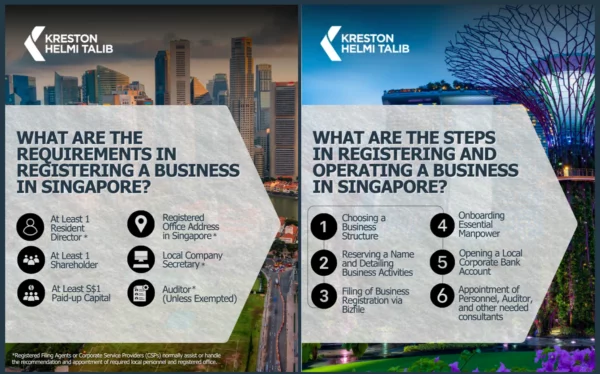
I. What Are The Requirements in Registering and Operating a Business in Singapore?
What does it take for foreign entrepreneurs to register and operate a business in Singapore.
The requirements include:
1. At least 1 Resident Director
For foreign entrepreneurs looking to establish a business in Singapore, one of the requirements is to appoint at least one resident director, authorised representative, general partner, or manager depending on your business structure. The director should meet the qualifications:
-
-
- At least 18 years old
- Of full legal capacity
- A Singapore citizen, Singapore permanent resident, EntrePass holder, or Employment Pass (EP) holder
- Not disqualified from acting as a director of a company (e.g. not an undischarged bankrupt)
-
You may find the list of required appointed individuals according to your entity type here.
Registered Filing agents or Corporate Service Providers (CSPs) can extend assistance on this regard, often appointing a nominee director on your behalf. Reach out to our team for assistance.
2. At least 1 Shareholder
An individual or corporate shareholder is required in incorporating a company in Singapore. In appointing one, no restrictions are imposed on the nationality, location or race. This means that 100% foreign ownership of shares is permitted. There are some requirements that each of your shareholders should have in handy.
Requirements For Individual Shareholders:
-
-
- Copy of the shareholder’s passport
- NRIC (if a Singapore resident)
- Professional Background Information
- Proof of Residence (Utility Bills, Rental Agreement, or Any ID indicating current residence)
-
Requirements For Corporate Shareholders:
-
-
- Certificate of Incorporation
- Company Constitution
- Business Profile
- Ownership and Governance
- Share Purchase Agreement (if any)
- Board Resolution (if Parent Company is a Shareholder)
-
More on shares and shareholders alongside other key details can be found here.
3. At Least S$1 Paid-up Capital
Shareholders are required to pay at least S$1 of paid-up capital to be eligible for business registration. Companies with paid-up share capital of S$500,0000 and above will automatically be members of Singapore Business Federation (SBF) granting them access to networking opportunities, and updates in the business ecosystem.
4. A Registered Office Address in Singapore
This is where all communications and notices to the company is addressed to and where your records are kept. As per ACRA requirements, the office should be open and accessible to the public for at least three hours during ordinary business days, for five days a week excluding public holidays.
CSPs such as our team at Kreston Helmi Talib also provide assistance on this regard, providing a registered local address to foreign business for registration.

Options to register a home office under this requirement is available for those who will conduct a small-scale business but should secure an approval under the Home Office Scheme managed by the Housing Development Board for HDB flats and the Urban Redevelopment Authority for private residential properties.
5. A Local Company Secretary
If you’re looking into setting up in Singapore as a foreign entrepreneur, a company secretary must be appointed within 6 months from the date of incorporation. If left vacant beyond this duration, the directors may face fines of up to S$1,000.
Responsible for a variety of administration and corporate compliance tasks, your corporate secretary can be a natural person or a local resident in Singapore but must not be the same person as the appointed sole director. Registered filing agents of Corporate Service Providers (CSPs) can be of assistance in the recommendation and appointment of your secretary.
6. Singapore-based Auditor (Unless Exempted)
While appointing an auditor is not required before you register your company, you are mandated to appoint one within the next 3 months of your incorporation unless you are exempted. Details on the Small Company Concept for Audit Exemption under Singapore’s Companies Act of 1967, details the factors that qualify a business into a small company.
As a main rule, your business can qualify as a small company if:
-
-
- You are a private company in the financial year in question; and
- You meet at least 2 of 3 criteria for immediate past two consecutive financial years
-
a. Total Annual Revenue < S$10m
b. Total Assets < S$10m; and/or
c. No. of Employees < 50
More concepts and circumstantial factors for exemptions can be found here.
II. What Are The Steps in Setting Up and Operating a Business Singapore?
Singapore’s business registration process is straightforward and is known to have one of the fastest turn around time in the world. Governed by ACRA and is largely digitized through the BizFile+ portal, Singapore’s one stop platform for business registration and compliance management, registering a business can be as simple as below:
1. Choose a Business Structure
Deciding on what type of entity to register in Singapore is of high importance as different regulatory rules and startup requirements governed different entities. From your business’ standpoint, choosing the right structure can grant you easier scalability or exit options should the need to expand, bring in investors or sell your business later, arise.
ACRA pointed out some key factors to consider when deciding on the business structure to set up.

As you weigh in these factors, you can then decide on which type of business structure is suitable for your current needs and future plans. The types of structures you can choose from can be accessed here.
2.Reserve Your Company Name
Great work! You now have decided on the type of business structure you will set up. The next in the books, is to reserve your Company Name.
The name must not be identical to that already registered by existing entities. You may check through Singapore’s business filing portal, Bizfile, for similarities. Accessing Bizfile requires:
-
-
- SingPass only available to residents and/or foreign individuals holding Foreign Identification Number (FIN) or entrepreneur passes (EntrePass) in Singapore; and/or
- CorpPass available for corporations already registered in Singapore.
-
If you don’t have either, you may engage a corporate service provider (CSP) to do a check and then register your unique business name through Bizfile for S$15. Approval of name reservation typically takes minutes unless the name contains certain words (e.g., ‘Bank,’ ‘Legal,’ ‘School’) that require referral to other agencies for verification purposes.
Once the application is approved it is then reserved for 120 days after which it will become available for registration of other entities if you do not proceed with your business registration.

Another part of this step is disclosing the primary and secondary activities of your business by choosing the most relevant Singapore Standard Industrial Classification (SSIC) code that corresponds to your intended business activity. You may visit the Singapore Statistics Department website to check the closest classification that relate to your respective industry based on your economic activity. See the updated classification list here.
After registration, some business activity may require you to apply for additional licenses or permits before you can start your operation.
You may find out more details here.
3. Register your Business via BizFile
If you still haven’t engaged a registered filing agent or CSP at this point, it’s high time you should. Unless you are a foreign entrepreneur with an Entrepreneur Pass (EntrePass) issued by Singapore’s Ministry of Manpower (MOM), only a filing agent can register your business on your behalf for S$300.
Engaging a registered filing agent will also exempt your directors and secretary from endorsing their applications via Bizfile as the CSP will do so on your behalf.
Upon approval, ACRA will issue a Unique Entity Number (UEN) that comes with a free business profile in Bizfile. This profile reflects all your company details.
Such entitles you to operate your business in Singapore unless your industry falls under any of Singapore’s regulated sectors where additional licenses or permits are required.
You may also opt to purchase a Digital Certificate of Incorporation for S$50 that certifies your business registration with ACRA.
4. Onboarding Manpower
If your business require manpower, this is the stage where you onboard your talents and form teams. You can engage local recruitment firms to do the screening process and HR & Payroll firms to manage their records, compensation and benefits and other key requirements set forth by the Ministry of Manpower.
Connect with our team for your payroll needs.
5. Opening a Bank Account
While you can commence operation right after having your UEN, opening a bank account is another key step to monitor your cashflows and seamlessly set up your tax compliance duties. While not mandatory for sole proprietorship, Limited Liability Partnerships and Companies are required to have a dedicated business account, as separate legal entities.
This step will require you, your directors or authorised signatories to complete the application process on your own. Depending on some banks, corporate bank account applications can be fully accomplished digitally.
6. Appointment of Company Secretary, Auditor, and Other Necessary Consultants
More than compliance, appointing your company secretary within the first 6 months of your business registration can ensure your records are kept, monitored and updated for easy tracking and decision making purposes. Appointing an Auditor within the first 3 months will help in getting your financial statements aligned with relevant standards for universal stakeholder and investor interpretation.
As you navigate a new business environment it is also imperative to consult with accountants and tax professionals which will help you manage your day-to-day financial transactions, track your cashflows and ensure you maximise tax discounts and benefits in all your business spendings.
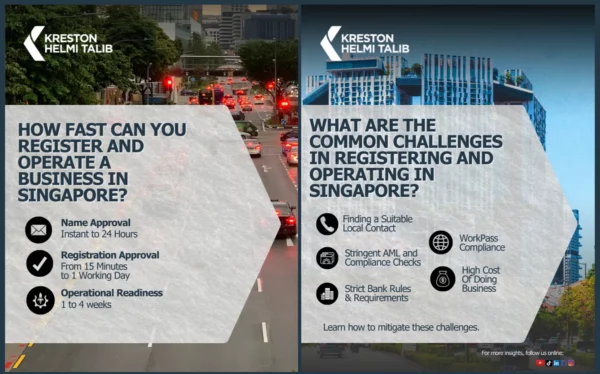
III. How Long Does it Take to Register a Business?
Singapore is known to have one of the fastest turnaround time in terms of business registration release.

If you have engaged a filing agent or a CSP, the process can be as highlighted below:
-
-
-
Name Approval: From a few minutes to 24 hours.
-
Incorporation Approval: From 15 minutes to 1 working day.
-
Operational Readiness: Becoming fully operational (opening a corporate bank account) typically takes 1 to 4 weeks as Singapore has strict monetary controls in place putting huge emphasis on due diligence.
-
-
IV. What Are the Common Challenges & Pitfalls When Incorporating in Singapore
-
Finding a Suitable Local Contact.
Many foreign entrepreneurs lack a local contact, leading to delayed, redundant or uncertain compliance and incorporation. Some CSPs whom they engage may also not complement their working style and needs. This can be mitigated by engaging a trusted CSP with decades of experiences and has a long-standing track record, from the early stages of your business registration.
See how our team can help. Connect with us.
-
Strict Anti-Money Laundering (AML) Checks
Singapore prides itself on its stringent financial controls and high standards in doing business. New standards, such as the Register of Registrable Controllers (RORC) can lead to heavy fines on beneficial owners for failure to maintain transparency. CSPs will be a huge help on this regard through their use of digitalised platforms that automates reminders for Annual Return Filing, Annual IRAS submissions and other compliance accountability of your newly registered business.
-
Bank Rules and Requirements
Banks in Singapore are highly selective. If your business model is vague or your source of wealth documentation is incomplete, account opening can stall and can delay business operations especially for some entity types. As long as you have your detailed business plan ready alongside credible records of your income streams, you can turn this challenge into confidence that your financial accounts and transactions are secure in all your dealings within Singapore.
-
Work Pass Compliance
Incorporating a company does not automatically grant you right to live in Singapore. You must apply separately for an Employment Pass (EP) or EntrePass which detail a list of requirements you need to take into account. You can simplify this process by engaging our team who can help you process your pass.
-
High Operational Cost
Setting up and running a business in Singapore costs undeniably higher compared to its Southeast Asian counterparts. This cost however can be offset by the booming opportunities in the country. Being one of the biggest economy in Asia and attracting consistent increase in Foreign Direct Investment (FDI) over the past years, incorporating in Singapore backed by the right experts holds great potential for returns.
Setting up in Singapore is efficient and seamless. With its highly digitalised and centralised platform for business registration and compliance management and its strict financial controls, the regulatory landscape is designed to reward transparency and professional conduct. As long as you ensure compliance to all regulations and engage credible and responsive CSPs, Auditors, Accountants, and Tax Consultants, you are one step away from scaling more success opportunities for your business.
Keen on expanding in other countries in Southeast and East Asia?
Connect with our global counterparts in the region who can be of help.