
All GST-registered businesses in Singapore will soon be required to onboard their systems with InvoiceNow. To digitalise national tax compliance, invoice data will be directly submitted to the Inland Revenue Authority of Singapore (IRAS) via the InvoiceNow network through Accredited Access Points (APs).
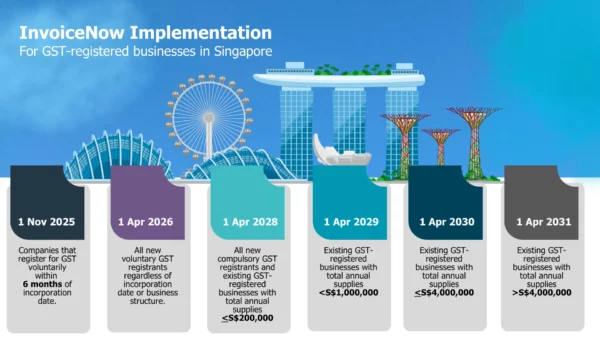
The mandate will be implemented in phases from April 2028 to April 2031, depending on the total annual supplies (i.e., standard-rated, zero-rated, and exempt supplies) made in all prescribed accounting periods ending in calendar year 2025.
The full implementation timelines are illustrated below:
IRAS has provided below things to consider for the implementation:
- Total annual supplies refer to the total value of standard-rated, zero-rated and exempt supplies made in all the prescribed accounting periods ending in calendar year 2025.
- Further details and information on the GST InvoiceNow Requirement implementation dates and phases will be available in the subsequent edition of the e-Tax Guide.
- Business may expect to receive a notification from IRAS notifying/reminding them of the respective mandatory implementation date by mid-2026. In the meantime, existing GST-registered businesses may self-help and use the Excel calculator to determine their applicable implementation date: GST InvoiceNow Implementation Date Calculator
If you are GST registered and is yet to adopt InvoiceNow, here are the key points to note for accurate compliance.
What is InvoiceNow
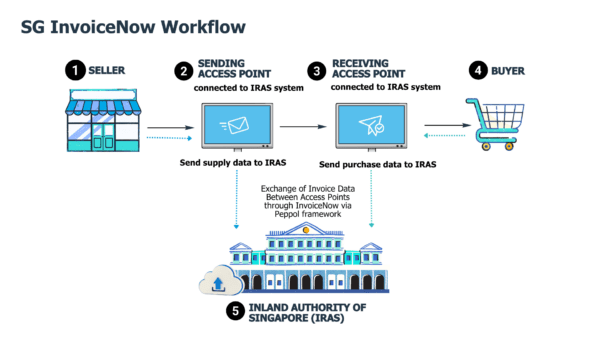
InvoiceNow is Singapore’s nationwide e-invoicing network. It enables businesses to transmit invoice data digitally. In contrast to the traditional pdf, paper or manual entry formats, businesses through InvoiceNow can :
- Send invoices digitally through the InvoiceNow network
- Automatically transmit invoice data to Internal Revenue Authority of Singapore
This creates a more accurate, real-time GST reporting process while minimising manual errors and fraud risks.
InvoiceNow works as below:
Most accounting solutions such as Xero and Sage are InvoiceNow ready so if you’re using any of them in this list, onboarding to InvoiceNow should take only a few steps.
What are the Steps in Onboarding to InvoiceNow
Step 1: Ensure your Solution is InvoiceNow-ready
Verify if your accounting/finance solutions is on the IMDA InvoiceNow-Ready Solution Provider (IRSPs) list that you can find here. If you are using an in-house enterprise solution, get in touch with an IMDA-accredited Access Point Provider (AP) to connect with the InvoiceNow Network here: go.gov.sg/invoicenowap
Step 2: Register for InvoiceNow and Obtain Peppol ID
Your business needs a unique digital address on the network for the system to identify an invoice’s provider and route it correctly to the recipient’s accounting software and to IRAS. This digital address is called a Peppol ID, which in Singapore is formatted as 0915:SGUEN<Your UEN>(e.g., 0195:SGUEN201912345A).
For InvoiceNow-ready solutions, reach out to your provider for them to register your business in the SG Peppol Directory where you can then obtain your Peppol ID.
For businesses using in-house solutions, you must engage any of IMDA-accredited Access Points (APs) provider. They will register on your behalf and handle the Peppol ID application for a fee.
Step 3: Enable the GST InvoiceNow Submission feature
If your accounting/finance solution is on the above list, contact your service provider and request them to activate the InvoiceNow feature on your existing software. In many cases, this is a simple setting they enable from their end, for an additional fee, if your provider is not included in this list of Free of Charge (FOC) IRSPs.

Those using an in-house enterprise solution should contact their Access Point provide to ensure that your solution is connected to IRAS and that the GST InvoiceNow submission feature is enabled.
What Are the Transactions to be Transmitted to IRAS?
Businesses are required to transmit to IRAS data on the following transactions that are reported in the GST return:
- Standard-rated supplies
- Zero-rated supplies
- Exempt supplies
- Standard-rated purchases
- Zero-rated purchases
The invoice data to be transmitted includes data on an invoice or an equivalent document that serves as bill for payment (or adjustment of bill for payment) for supplies and purchases made. Examples of documents that serve as bill for payment include sales invoice, tax invoice, simplified tax invoice, serially numbered receipts, debit notes and credit notes.
Businesses can choose to aggregate supplies data from point-of-sale system, supplies where simplified tax invoices are issued, and petty cash purchases data before transmitting to IRAS.
Meanwhile, invoice data on the below types of transactions are excluded from the scope of data collection and need not be transmitted to IRAS:
- Transactions where there are no underlying supplies or purchases but are regarded as supplies or purchases to be reported solely for GST purposes. Examples include deemed supplies, goods exported without sales
- Reverse charge transactions
- Exempt financial services, and exchange or loan of digital payment tokens
- Import permits for importation of goods
What Support Can I Get in Implementing InvoiceNow Requirement?
The government has laid out several support measure and financial assistance to aid businesses in the implementation.
A. GRANTS
- For Small and Medium-Sized Enterprises (SMEs)
- Businesses using IMDA-accredited InvoiceNow-Ready Solution Provider (IRSPs) may be eligible to apply for the Productivity Solutions Grant (PSG) and receive up to $30,000 for IT solutions and equipment, including InvoiceNow-Ready Solutions.
- A new grant of up to $1,000 will be introduced for SMEs to defray the operational costs of adopting InvoiceNow-Ready software. More details on the support provided will be released by IMDA and IRAS in due course.
- For Larger Businesses
- A new grant of up to $5,000 will be provided for early adopters. More details on the support will be released by IMDA and IRAS in due course.
B. Free-of-Charge Solutions
The Inland Revenue Authority (IRAS) has worked with the IRSPs to provide Free-of-Charge (FOC) solution packages for businesses to adopt the mandate. IRSPs offering FOC solutions can be found here.
IRAS encourages all GST-registered businesses to adopt early for seamless transition ensuring invoice data are accurately transmitted to using InvoiceNow-Ready Solutions via the InvoiceNow network. Compliance ensures you maintain your GST status and avoid regulatory fines.
Reach out to our team to assist you with the adoption as early as today.