

Singapore Budget 2026 For Local Businesses and Foreign Investors
Singapore ended 2025 in a much stronger financial position than forecasted. The previous year’s S$15.1 billion budget surplus came more than double the estimate of S$6.8 billion. This was driven by better-than-expected 5% growth, economic performance, increased corporate tax, and Certificate of Entitlement (COE) collections.
2026 growth is a more muted projection at 2-4%.
Singapore Budget 2026, themed 'Securing Our Future Together in a Changed World,' focuses on economic resilience, artificial intelligence (AI) leadership, and workforce development. It aims to help businesses navigate a fragmented, volatile, high-cost environment while fostering long-term growth and competitiveness. Prime Minister Lawrence Wong has anchored this year's budget speech to three key focus areas:
- Economic Resilience and Stability
- Addressing Cost Pressures and Support for Singaporeans
- Future-Proofing Fiscal Strategy for the Years Ahead
Set up as the nation's strategic roadmap to a strengthened economy and bolstered society in the coming years, here's a quick overview of the support measures and initiatives covered in Budget 2026 to support households, workers, and businesses.
1. Advancing Economic Strategy
- Support high-value investments with a S$37 billion Research, Innovation, and Enterprise fund (RIE2030 plan)
2. Accelerating AI adoption
- Sector-Focused AI Missions: Strategic initiatives to accelerate AI adoption in Advanced Manufacturing, Connectivity, Finance, and Health.
- Champions of AI Programme: Provide tailored support to companies undertaking AI-driven business transformations.
- Enterprise Innovation Scheme (EIS) Expansion: Includes qualifying AI expenditures for a 400% tax deduction, capped at S$50,000 annually for YA 2027 and YA 2028
- Free 6-month AI Subscriptions Access to premium AI tools for Singaporeans taking selected AI-related courses.
3. Business Competitiveness and Internationalisation
- Startup SG Equity: S$1 billion for startups, include growth-stage companies
- Market Readiness Assistance (MRA) Grant: Enhanced support levels of up to 70% for SMEs.
- Global Innovation Alliance (GIA) a network of Singapore and overseas partners with a focus on technology and innovation, for companies to connect and grow businesses with global innovation ecosystems
- Double Tax Deduction for Internationalisation (DTDi): Automatic claim cap raised from S$150,000 to S$400,000 from YA 2027
4. Workforce and Skills Development

- Career Agency Merger:SkillsFuture Singapore (SSG) and Workforce Singapore (WSG) to merge as a single statutory board to provide seamless job-matching and training services.
- Progressive Wage Credit Scheme (PWCS):Co-funding support increased to 30% for 2026 and extended until 2028 to manage rising wage costs.
- Workforce Levies and Salaries:
- Local Qualifying Salary (LQS)of full-time employees increased to S$1,800 from July 2026.
- EP and S Pass Thresholds:Minimum qualifying salaries will rise in January 2027; From S6,200 to S$6,600 for financial services sector and S$5,600 to S$6,000 for all other sectors.
5. Support for Families and Seniors
- Cost-of-Living Payouts:Eligible Singaporeans will receive a one-off cash payment between S$200 and S$400 in September 2026.
- Household Vouchers:All households will receive S$500 in CDC vouchers in January 2027.
- Child LifeSG Credits:A boost of S$500 per child aged 12 and below in July 2026.
- Senior Support:
- CPF Top-ups:Up to S$1,500 for seniors aged 50 and above with retirement savings below a certain threshold.
- New CPF Investment Option:Introduction of low-cost, diversified life-cycle investment products from 2028.
- CPF Top-ups:Up to S$1,500 for seniors aged 50 and above with retirement savings below a certain threshold.
Singapore Budget 2026 for Local Businesses and Foreign Investors
Budget 2026 touched on Singapore’s strategic move to adapt to today’s changed world and boost economic resilience amidst geopolitical risks and technological shifts. Much of the agenda is anchored in support measures to help local businesses remain competitive and globally-oriented while creating an attractive ecosystem for foreign investors.
Here are some reliefs that local businesses and international investors can benefit from.
Corporate Support
A corporate income tax rebate of 40% of the tax payable will be granted for Year of Assessment (“YA”) 2026. Companies that meet the local employee condition* will also receive a (non-taxable) S$1,500 CIT rebate cash grant, with a maximum total benefit of S$30,000. Eligible companies will automatically receive the benefits from Q2 of 2026.
This measure provides immediate cashflow relief to active companies.
*A company meets the local employee condition if it has made CPF contributions to at least one local employee, excluding shareholders who are also directors in the previous calendar year.
Double Tax Deduction for Internationalistion (DTDi) Scheme
Businesses can automatically claim 200% tax deduction on the first S$150,000 on eligible expenses incurred on qualifying market expansion and investment activities.spent without prior approval of the EnterpriseSG or Singapore Tourism Board. Applying to expense incurred from YA2027, the expenditure cap without prior approvalis raised from S$150,000 to S$400,0000 per YA.
Scope is expanded to cover overseas market development and investment research trips and more activities.
Enhanced Grant Support for Overseas Market Access
From 1 April 2026 to 31 March 2029, local SMEs* will receive support of up to 70% (from the current 50%) of eligible costs (non-SMEs, up to 50%) incurred for overseas market promotion, business development, and market set-up, capped at S$100,000 per company per per new market.
From Q2 of 2026, the grant support is given to SMEs to deepen their presence in existing (not just new) overseas markets.
The enhanced overseas expansion grant encourages local, growth-stage companies to explore global markets for more growth avenues.
* Companies with group annual sales turnover not exceeding S$100 million or employee numbers not exceeding 200
Strengthening Business Enterprise
So that Singapore is seen as a choice venue for companies seeking to list, the government is allocating S$1bn to strengthen StartUp SG Equity to help startups scale and anchor quality public listings.
Whilst the Startup SG Equity scheme has mainly focused on early-stage funding, it will now expand to cover growth-stage companies as well. A 2nd tranche of S$1.5bn goes to the Anchor Fund launched in 2021 to attract and anchor high-quality listings on the SGX.
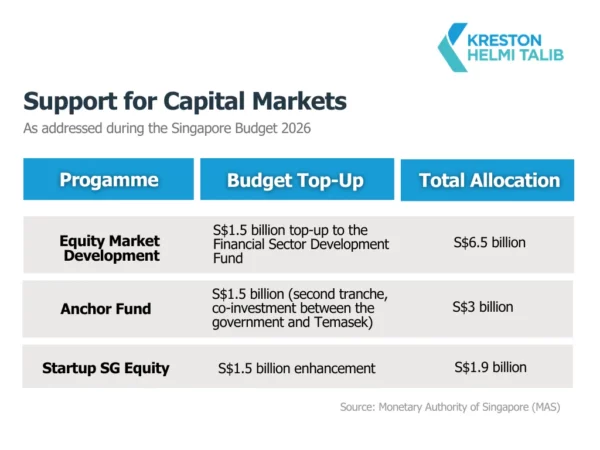
These allocations are expected to strengthen Singapore’s enterprise, equities ecosystem and broaden nvestor participation.
Enhancements to the
Enterprise Innovation Scheme (EIS)
From YA2024 to 2028, businesses are eligible for a 400% tax deduction/allowance on up to S$400,000 of qualifying expenditure per YA for each of the 1st four qualifying activities below (1-4). The 5th activity is eligible for S$50,000 deduction.
- Qualifying Research & Development (R&D) undertaken in Singapore
- Registration of Intellectual Property (IP)
- Acquisition and Licensing of IP rights
- Training courses that are eligible for SkillsFuture Singapore (SSG) funding and aligned with the Skills Framework
- Innovation projects carried out with polytechnics, the Institute of Technical Education (ITE) or other qualified partners
For YA 2027 to 2028, an additional 6th activity will be introduced for qualifying AI expenditure capped at $50,000 per YA. The option to convert to a cash payout is not available.
The list of qualified partners for innovation projects is expanded to include Sectoral AI Centre of Excellence for Manufacturing.
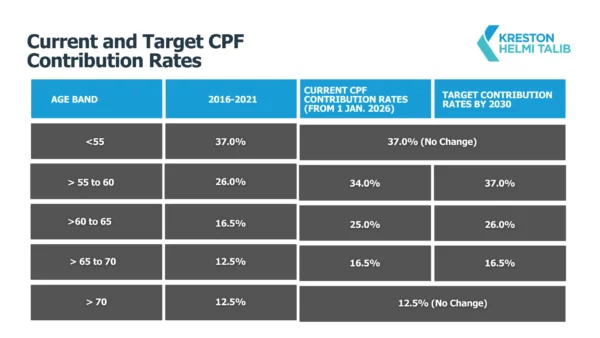
Senior Worker CPF Contribution Rates and CPF Transition Offset
The Government announced in 2019 a gradual increase in CPF contribution rates for Singaporean and PR workers aged above 55 to 70.
Table 1: Current and target CPF contribution rates by age bands
The table below shows the increase in senior workers’ CPF contribution rates, from 1 January 2027, for those aged above 55 to 65.
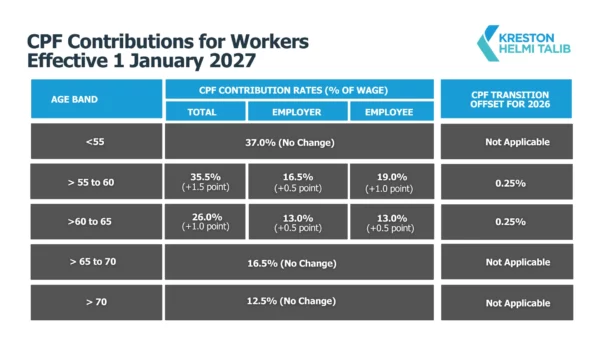
Employers will automatically receive a one-year CPF Transition Offset that covers half of the increase in employer CPF contributions.
National AI Mission
Budget 2026 positions artificial intelligence (AI) as a core driver of Singapore’s economic strategy, with enhanced tax incentives and grants to accelerate business adoption.
- A new National AI Council, chaired by the Prime Minister, will coordinate Singapore’s AI agenda, alongside National AI Missions in advanced manufacturing, connectivity/logistics, finance, and healthcare.

- The Productivity Solutions Grant (PSG) will also be expanded to support businesses in AI Adoption via wider range of AI-enabled solutions.
- A new “Champions of AI” programme will provide tailored support for firms undertaking end-to-end AI to transform their business.
- JTC will establish an AI park at One-North as a focal point for innovating, text-bedding, and scaling AI solutions.
- TechSkills Accelerator (TeSA) will be expanded to extend key AI training, transitioning mid-career workers into accountancy and legal professionals.
- Workforce upskilling remains a focus, with expanded AI training and 6-month free access to premium AI tools for individuals completing selected courses.
AI is now a mainstream, incentivised business investment. Companies should start identifying qualifying AI expenditure and tap onto the EIS S$400,000 deduction of up to S$50,000 expenditures for YA 2027 and YA 2028.
Further details on the updates discussed will be progressively released by the relevant government agencies in the coming months for implementation timelines and specific support measures.