
In recent years, the accounting industry has been at the forefront of embracing technological shift. The Accounting Entity (AE) survey, an annual report released by the Accounting and Regulatory Authority (ACRA) has shown that up to 85% of Accounting firms in Singapore have adopted one or more technology solution in the past year, a jump of 3% from the preceding period. Particularly, a 5% increase on firms adopting AI can be seen.

In the coming years, this number is expected to increase with several government grants and schemes that push for more focus on the use of AI. In YA 2027 , the list of qualifying activities that qualify businesses for up to 400% tax deductions on up to SGD 50,000 of expenditure per year, have been updated to include AI adoption, under the Enterprise Innovation Scheme (EIS).
The Institute of Singapore Chartered Accountants (ISCA) in partnership with the Infocomm Media Development Authority (IMDA) has recently launched AIxAccountancy, a national AI training initiative for industry practitioners. It covers 30 hours of self-paced courses backed with practical assessments and real-world AI agents as requirements for training completion.
Kreston Helmi Talib was an early adoptee and became the first Small and Medium Practice (SMP) to achieve 100% firm-wide completion, with more than 100 employees finishing the programme from the Managing Partner to every staff. This added credential enables our team to create AI agents that support multi-step workflows to take on repetitive, rules-based task.
For clients, this does not signify less work for accountants at a lower costs. By investing in both AI tools and the required skills for its responsible use, time spent on recurrent processes is redirected towards review, analysis, judgement and advisory work. And the result: greater productivity, more consistent quality, and faster, more seamless communication, without reducing the level of professional scrutiny behind the work.
What are AI Agents?
The age of generative Artificial Intelligence (AI) has paved the way for a new phase of automation, the agentic AI. While generative AI responds to a set of prompts, AI agents go a step further. Within defined boundaries and guided by set rules, AI agents work towards a goal, autonomously decide on the next steps and interact with authorised systems, data and knowledge resources to accomplish the set goals.
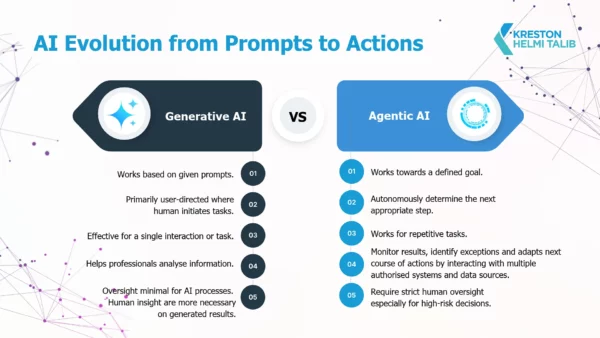
In Accounting this could mean agents taking on mundane and repetitive tasks, further allowing time and capability for accounting professionals to focus on the more complex side of the job in areas such as audit opinions, accounting estimates and complicated tax decisions.
What does this mean for your Business?
If you are engaged with an accounting or advisory firm, you can anticipate faster turnaround times on quality reports and more automated workflows.
Further, the opportunity extends beyond the services you can receive from your service provider. Your organisation can also explore how AI agents can be integrated into your own finance and operational processes. AI agents can provide you with a stronger visibility over financial information that creates a more responsive process between you and your advisors that then reduce bottlenecks and back-and-forth communication during peak periods and reporting deadlines.
Governance and Responsible AI Use
The Institute of Singapore Chartered Accountants has recently released a framework for the responsible use of AI in Accountancy. Parallel to such, the IMDA has also published a comprehensive governance guidelines on the use of Agentic AI that both supplements an accounting firm’s internal AI policy.
These resources serve as implementation guide for accounting professionals on responsibly adopting AI, with particular emphasis on protecting client data, maintaining appropriate human oversight, managing AI-related risks and ensuring accountability for AI-assisted work.
Particularly in practice, at Kreston Helmi Talib, the AI agents are assessed and approved before deployment and are required to operate in accordance with the Firm’s internal AI policy. This is to ensure that the AI agents created will only work on approved tasks such as data organisation, document classification, information extraction, preliminary research, data validation and other repetitive works.
All work involving AI is subject to a team leader’s review and some cases call for additional confirmation from the Firm’s Quality Assurance department to ensure client data is handled only within authorised systems and in line with the Firm’s confidentiality, access control and data protection requirements.
As Agentic AI will soon be at the core of workflows and business operations, strong governance in place is imperative. For Accounting firms, this means ensuring the agents are configured in clear defined boundaries, governed by appropriate controls, and all works are still reviewed with strict professional judgment remaining firm in place.
How can Businesses Navigate the Agentic Era of AI
For businesses, navigating this next stage will mean ensuring that financial data is reliable, internal controls remain robust and AI is adopted with appropriate governance and human oversight. As routine processes become increasingly automated, the value of accounting professionals will shift further towards interpreting results, challenging assumptions and helping businesses make informed decisions.

For Accounting firms, embracing AI agents mean improving on the outcomes delivered and earning quality time and capabilities for tasks that require professional judgment, industry expertise, human interpretation. This is tied up to the promise of delivering a more responsive, insightful and value-adding solutions that adapt to changing business needs.
Reach out to our team to learn how we commit to providing bespoke client services whilst ensuring we remain adaptive to the changes in the profession.