
As business landscapes and consumer behaviors evolve, financial reporting follows suit. With the introduction of the Financial Reporting Standards (FRS) 118: Presentation and Disclosure in Financial Statements, businesses in Singapore will have to rethink how they present and communicate their financial performance in a transparent and consistent manner to boost investor and stakeholder confidence. While the new reporting standard does not change transaction recognition, it significantly altered how financial transactions are structured and disclosed.
For business owners, finance leaders, auditors, and accounting professionals, understanding FRS ahead of its January 2027 implementation date can help avoid last-minute adoption challenges and ensure seamless transition. Curated in this short read is a comprehensive summary of the updates, their impact on financial reporting and an implementation guide.
What is FRS 118?
FRS 118 is Singapore’s equivalent of IFRS 18 and will replace FRS 1 as the primary standard governing the presentation and disclosure of financial statements. The standard applies to annual reporting periods beginning on or after 1 January 2027, although early adoption is permitted. It must also be applied retrospectively, meaning comparative financial information will need to be restated.
The standard responds to investor demand for more comparable income statements, greater transparency over management performance measures, and better aggregation and disaggregation. Net profit is not changed merely by adopting the new presentation model, but many entities will need substantial changes to statement formats, mappings, reporting packs, controls and audit procedures.
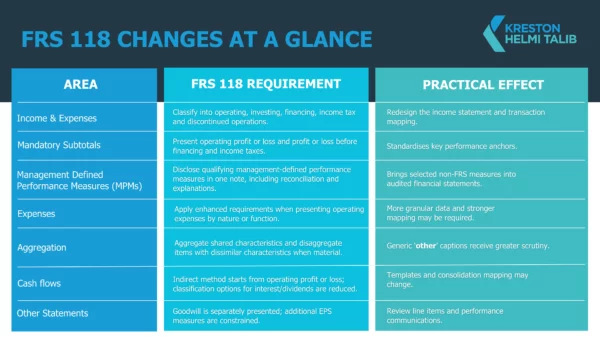
Key Changes at a Glance
One of the biggest misconceptions about FRS 118 is that it changes profitability. In most cases, the standard does not. Rather it changes how financial information is organised, classified and disclosed. Key changes are highlighted here:
What Changes and What Does Not
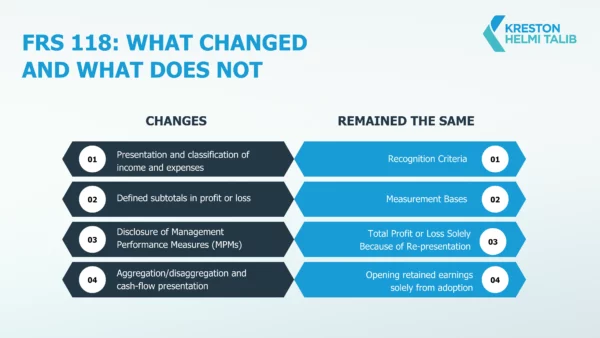
The standard does not generally alter recognition criteria, measurement bases, or total profit and loss. For better understanding, curated here is the summary of changes and areas that remained.
The Three Pillars
FRS 118 is built around three key pillars.
1. Structured Statement of Profit orLoss
Under FRS 118, companies must classify income and expenses into five distinct categories.
- Investing – Returns from stand-alone investments and related incremental expenses, subject to the standard’s detailed requirements.
- Financing – Income and expenses from liabilities arising from transactions involving only the raising of finance, plus specified effects from other liabilities.
- Income Tax – Tax expense or income included in profit or loss.
- Discontinued Operations – Income and expenses from discontinued operations under FRS 105.
- The operating category is the default category, subject to specified requirements and adaptations for entities whose main business activities involve investing in assets or providing financing to customers.
In addition, two mandatory subtotals must be presented:
-
- Operating Profit or Loss
- Profit or Loss Before Financing and Income Taxes
These standardised subtotals create greater consistency across financial statements, making it easier for investors, regulators, and other stakeholders to compare performance across organisations.
How The Standard Impacts Your Business:
For many companies, the current income statement may already contain customised groupings and non-standard subtotals. FRS 118 requires organisations to reassess these classifications and ensure transactions are mapped correctly into prescribed categories.
This could lead to substantial changes in reporting structures, especially for businesses with complex financial arrangements, investment activities, or multiple reporting systems.
2. Management Defined Performance Measures
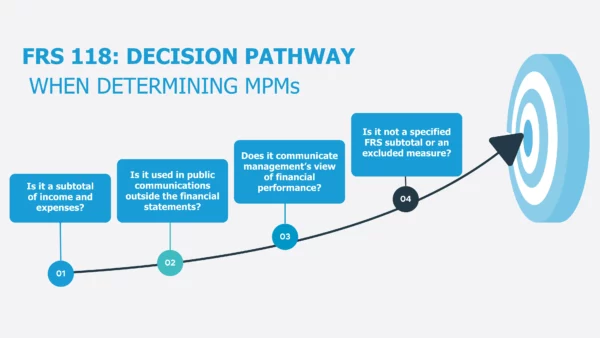
A management defined performance measure(MPM) is a subtotal of income and expenses that is used in public communications outside the financial statements, communicate management’s view of an aspect of financial performance, and is not a subtotal specifically required by FRSs or otherwise excluded by FRS 118.
Deciding whether certain measures qualify as MPMs follows the decision pathway below.
Required Disclosures in a Single Note:
- A description of why the MPM communicates management’s view and how it is calculated.
- A reconciliation to the most directly comparable FRS subtotal or total.
- The income-tax effect and effect on non-controlling interests for each reconciling item.
- An explanation that the MPM reflects management’s view and may not be comparable with similarly labelled measures used by others.
- Changes to, additions of, or cessation of an MPM, including the reasons and restated comparative information unless impracticable.
How the Standard Impacts your Business:
Many business regularly use alternative performance metrics in annual reports, investor presentations, press releases or management commentary. FRS 118 increases accountability by requiring these measures to be clearly explained and reconciled back to the statutory financial information. This boosts transparency and help users better understand management’s view and performance.
3. Better Aggregation and Disaggregation of Financial Information
Another major focus of FRS 118 is improving quality of information presented in financial statements. The standard requires entities to aggregate items when they share characteristics and disaggregate such when dissimilar characteristics are material to understanding the information.
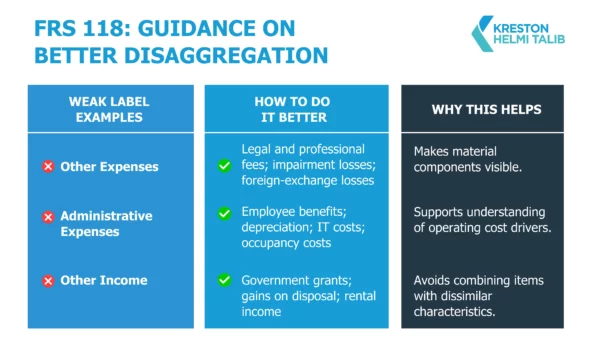
This means generic line items such as ‘Other Expenses’ or ‘Other Income’ may require further breakdown where the underlying items are sufficiently different or significant.
See below guide for more information.
Important Thing to Note: In the case of businesses already presenting the expenses in broad categories and by function, FRS 118 requires additional disclosures. The standard requires specified nature-based amounts to be disclosed in a single note. The required information includes depreciation, amortisation, employee benefits, impairment losses and reversals, and inventory write-downs and reversals, together with the line items in which those amounts are included.
How The Standard Impacts your Business:
The degree of impact will depend on current presentation practice, business model, use of alternative performance measure, system architecture and the volume of public communications.
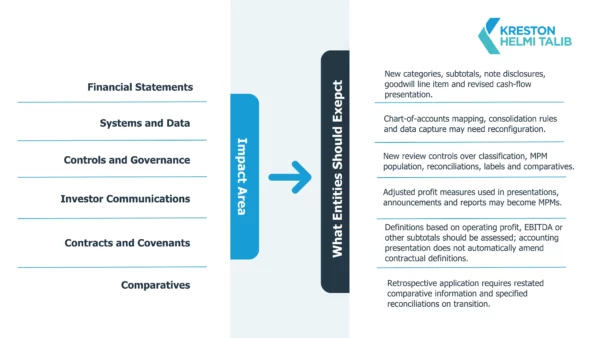
Entities likely to prepare in greater effort are as follow:
- Listed entities and entities with extensive investor communications or alternative performance measures
- Groups with complex financing structures, investments or foreign-exchange exposures
- Entities whose main business activities include investing in assets or providing financing to customers
- Groups using multiple ledgers, reporting packages or non-standard profit subtotals across components
How The Standard Impacts Cash-flow Statement
FRS 118 changes cash-flow classification-not total cash. Under the indirect method, operating profit or loss becomes the starting point, requiring updates to mappings, reporting packs and controls. The table below summarises the changes to the classification requirements under FRS 7 arising from FRS 118, including the distinct requirements applicable to entities with specified main business activities.
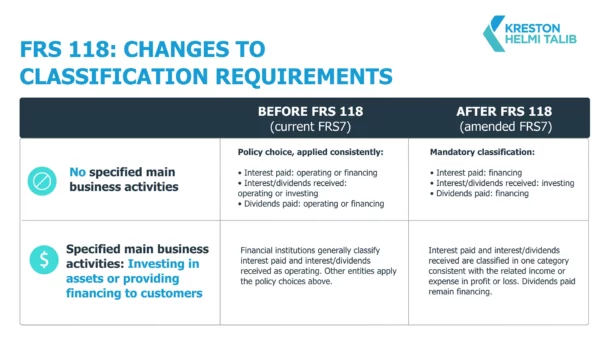
The revised classification requirements may change the amounts reported within operating, investing and financing activities and, consequently, cash-flow-based performance measures, while total cash and cash equivalents remain unaffected. Entities should assess whether they have specified main business activities and reflect the resulting classification requirements in their accounting policies, general-ledger and consolidation mappings, financial statement templates, and related internal controls.
Minimum Readiness Checklist
To be ready for the 2027 implementation, business, and accounting professionals should take note of below.
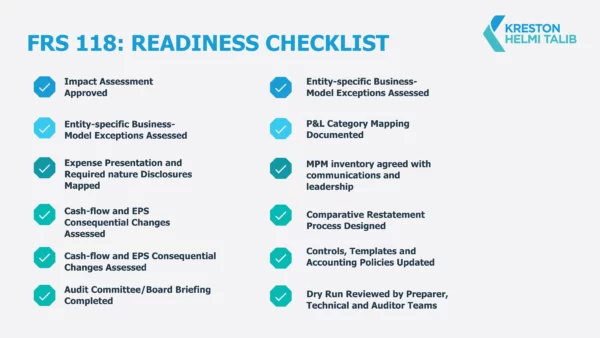
In a nutshell, FRS 118 is more than a new format. It changes how performance is structured, governed, audited and communicated.
Need assistance with implementing the changes? Reach out to our team.