Hacking Global Business Growth Through Outsourcing

Expanding internationally is one of the most effective ways to drive growth, unlock new markets, and diversify revenue streams. In hindsight, going global brings about significant challenges, especially in today's volatile markets and complex cross-border regulatory requirements. This sentiment is backed by numbers as presented in the recent Kreston Global survey, the Interpreneur Report. The report examines the expansion outlook of over 1,100 mid-market business leaders worldwide and offers insights for entrepreneurs looking to expand beyond their local jurisdictions.
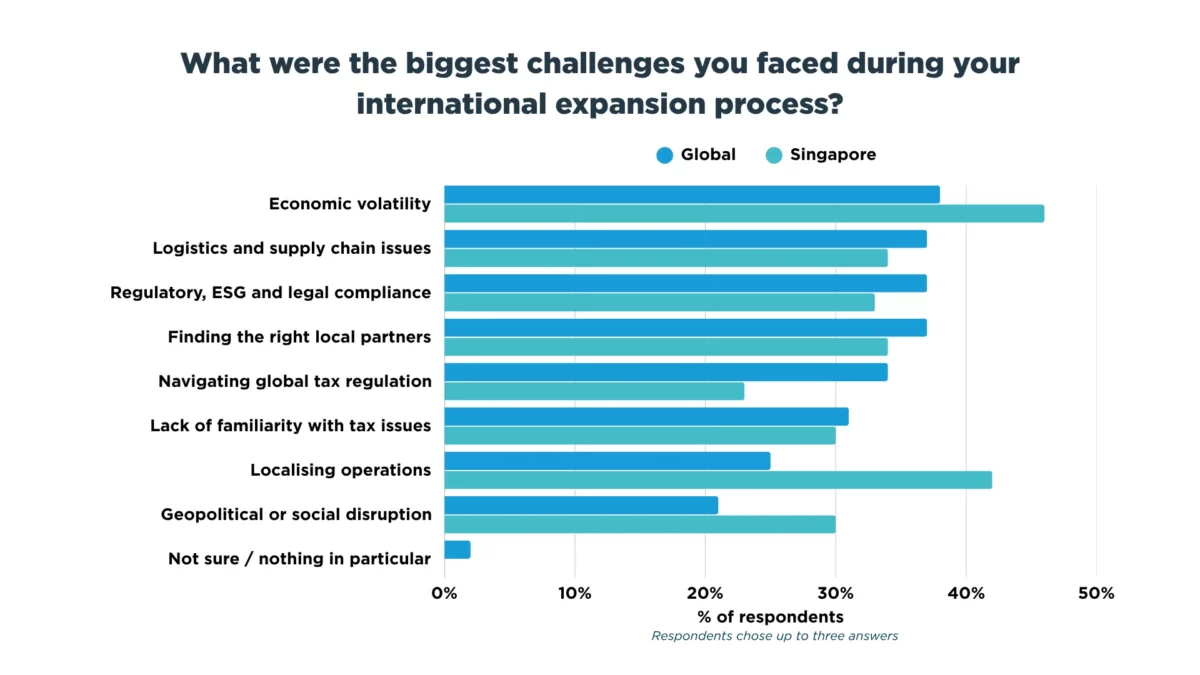
Data from the Report shows that geopolitical instability, tariffs, and regulatory complexity remain top-of-mind concerns even as overall sentiment about expansion remains positive. In Singapore particularly, only 29% of the surveyed business leaders felt at ease with global expansion given the rising geopolitical tensions and supply chain disruptions, while 40% considered it difficult. The key challenges they are wary of are presented below.
On top of this, businesses, especially small and medium-sized enterprises (SMEs), whether expanding into Southeast Asia or a mid-market firm anywhere else, face more operational challenges when expanding beyond borders:
- Regulatory Complexities. Tax rules, filing deadlines, and compliance requirements differ by country and change often. What was compliant last year in one market may not be this year.
- Tariff and Trade Volatility. Trade disputes are actively reshaping costs and sourcing decisions for many expanding businesses especially as the world faces geopolitical tensions.
- Currency Exposure. Every new market is another currency to track, forecast, and protect against, and most in-house teams aren't set up to do that well.
- Talent and Bandwidth Gaps. Hiring a finance team with jurisdiction-specific expertise for every new market takes time, expensive, and often impossible to justify for one or two markets at a time.
- The Partnership Dilemma. Many businesses are pursuing joint ventures or local partnerships to enter new markets, which adds a whole additional layer of shared reporting and accounting complexity that most internal teams have never had to handle before.

Individually, each of these is manageable. Together, and across multiple markets at once, these are where expansion plans oftentimes go sideways.
Why in-house Accounting struggles to Keep Up
While building an in-house function that can handle all of these challenges isn't impossible, it takes massive resources---financial, time, and manpower, to build efficient, cross-functional teams who can keep abreast and adapt as quickly as the business landscapes evolve.
In practice, this shows up in different ways:
- Hiring (or training) someone with tax and compliance knowledge specific to each new country
- Keeping the team informed and updated to standard updates and regulatory changes
- Building and maintaining separate reporting processes for consolidation, currency translation, and intercompany transactions
- Absorbing the cost of mistakes, a missed GST filing deadline, a misclassified employee, a currency exposure nobody flagged, which are often far more expensive than the accounting work itself would have cost
Building in-house teams may be a good solution for bigger businesses, but mid-market growth can rely more on outsourced support that can function across jurisdictions in a timely, high-quality, and efficient manner.
The Cost Comparison
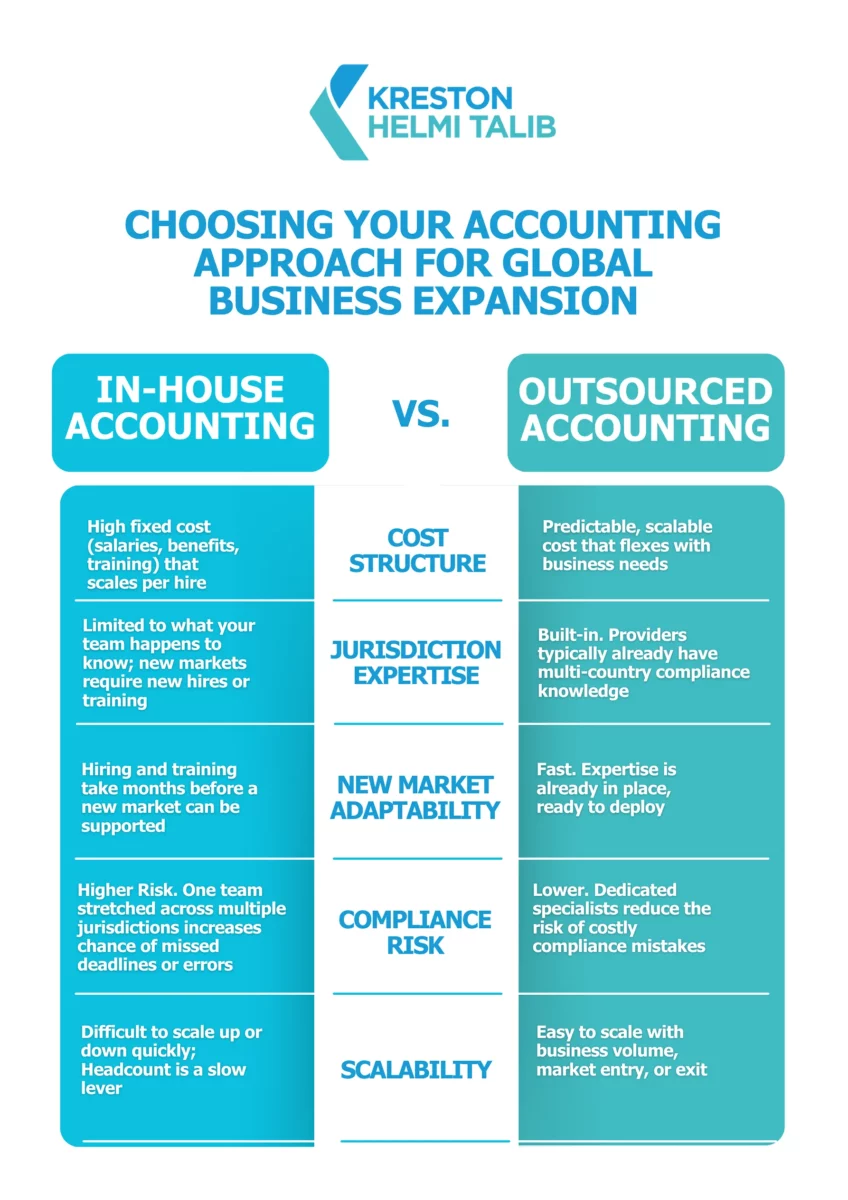
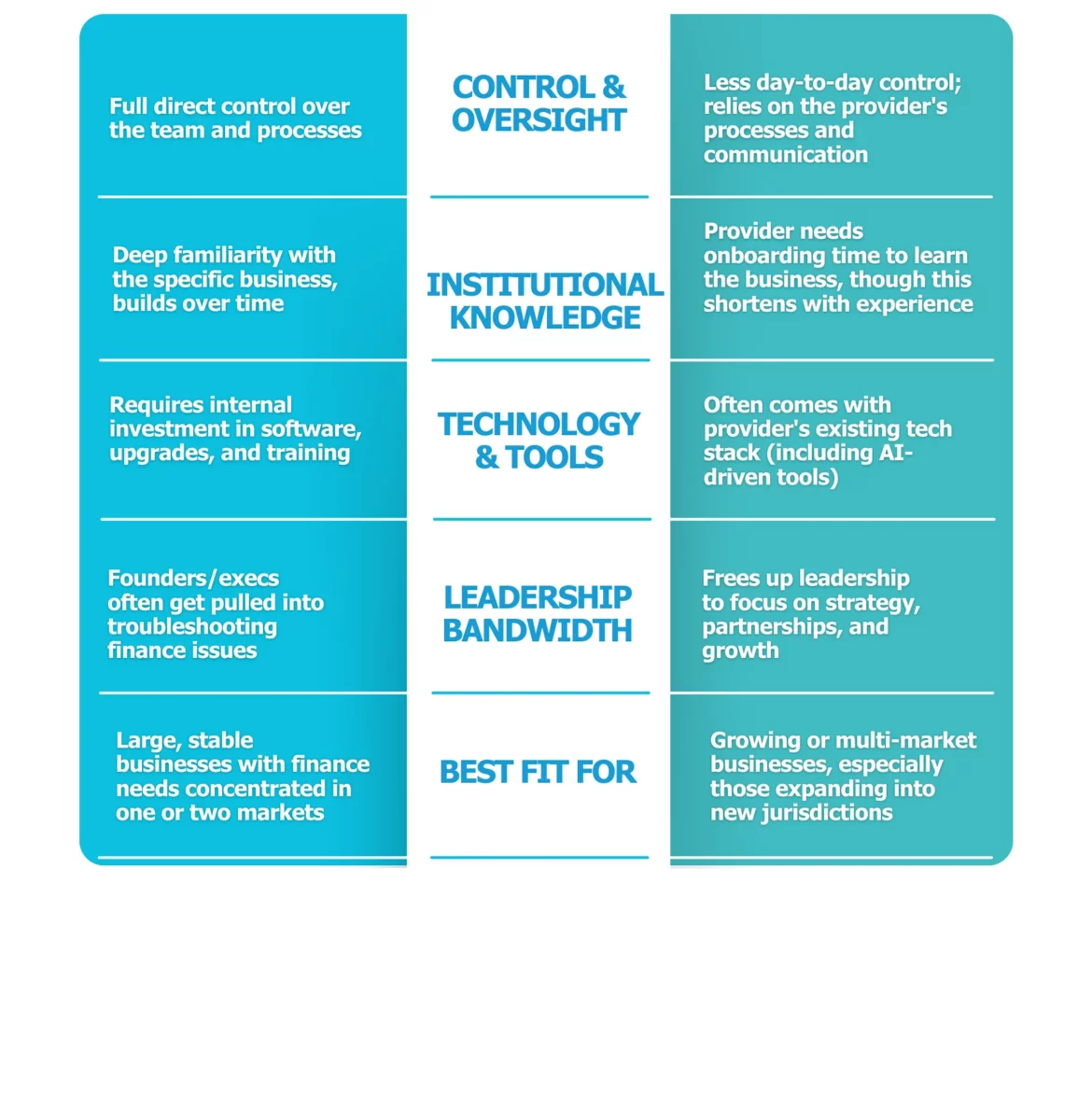
When businesses weigh 'in-house' vs 'outsourced accounting support, they usually compare it as a straight cost-per-hour or cost-per-headcount decision.
The real comparison lies beyond the numbers.
How Outsourcing Can Help
Outsourcing your accounting and bookkeeping function provides your businesses with accurate, compliant, and timely financial insights, through a team of experienced professionals. If you are expanding and is managing multi-country operations, outsourcing your needs to a partner with a multi-jurisdictional presence simplifies cross-border compliance seamlessly. At Kreston Helmi Talib alongside our Kreston Global colleagues around the world, our team of highly-skilled accountants brings:
- Jurisdiction-specific compliance knowledge, so tax and regulatory requirements are handled correctly the first time, in every market
- Built-in scalability, so finance support grows with the business without a hiring lag every time a new market opens
- Consolidated, accurate reporting across currencies and entities, giving leadership a clear, real-time view instead of a monthly scramble
- Proactive risk flagging, catching currency exposure, filing deadlines, and compliance gaps before they become expensive problems
- Freed-up leadership bandwidth, so founders and executives can focus on the partnerships, market entry, and growth decisions that actually require their attention
For businesses navigating the kind of uncertainty the Interpreneur Report describes (tariff volatility, regulatory complexity, and the operational demands of new joint ventures and partnerships) outsourcing the right providers will bridge the gap between your business' global expansion goals and the complexity that comes with it.
Finding the Right Support
When choosing potential outsourcing partners to support your expansion endeavours, it is worth asking these questions.
- Do they have expertise in your target markets?
A partner that's strong in one country but unfamiliar with your target market adds a second layer of risk, essentially outsourcing the learning curve along with the work. - Can they support your requirements across multiple jurisdictions?
Piecing together separate local providers market by market means disconnected reporting, inconsistent standards, and no single point of accountability. It is best to look into a network of accounting professionals who have presence in all the markets you plan to enter.
Take Kreston Helmi Talib for example who has Kreston Global colleagues in over 100 countries worldwide. Connecting with our team means connecting with our counterparts globally where consistent and seamless standards and local expertise are at the core of what we do.
- Will you get one consolidated view, or fragmented reports from disconnected providers?
Real-time, consolidated reporting across currencies and entities is imperative. Kreston Helmi Talib's counterparts around teh world means these are built into how we work. It will give you a single accounting and bookkeeping partner with local expertise across over 100 countries, backed by consistent global standards, rather than a patchwork of disconnected local providers. - Can they scale with your growth?
Look for a partner who can grow with your expansion plans without requiring you to re-onboard a new provider every time you enter a new country.
The right answers to these questions should always be anchored in your business’s unique needs first and foremost. Beyond cost considerations, it is equally critical to assess your industry-specific requirements, regulatory environment, and long-term growth ambitions.
Ultimately, choosing the right provider is less about ticking boxes and more about finding a partner who can align with your vision, integrate seamlessly with your operations, and proactively support your expansion journey. From leveraging technology and ensuring compliance to delivering timely insights and scalable solutions, the right partner becomes an extension of your team.
At Kreston Helmi Talib, we take this partnership approach seriously. Our outsourcing solutions are designed to go beyond operational support and more into building partnerships where we can grow together.
Connect with our team.